Once the leaves start coming down across Rockville, the trees that have been nagging at homeowners all summer are suddenly easy to see: the oak with the dead top, the silver maple leaning toward the garage, the ash that never leafed out properly. Late fall and winter are when many people finally schedule tree removal in Rockville MD, and the city adds a layer that most of Montgomery County does not have. Rockville runs its own tree ordinance, owns the trees along its streets, and runs a leaf collection program that shapes how fall yard work gets done.
This article walks through what Rockville’s rules actually require, which trees on or near your property you are allowed to remove, and what a well-run removal looks like from the first estimate to the final rake. The short version: for most single-family homeowners, the city’s rules are less of a hurdle than their reputation suggests, but there are a handful of situations where they matter a great deal.
Rockville Tree Removal Rules: How the City Differs from the Rest of Montgomery County
Rockville is an incorporated city, so it writes some of its own rules. Tree protection falls under the city’s Forest and Tree Preservation Ordinance (FTPO), Chapter 10.5 of the Rockville City Code. The Mayor and Council amended it on January 12, 2026, mainly to bring it in line with current state forest conservation law, and the changes took effect immediately.
That is a real difference from nearby Bethesda, which is unincorporated and falls directly under Montgomery County rules with no city ordinance layered on top. Two homeowners a few miles apart can face different sets of questions for what looks like the same job.
The ordinance revolves around one term. A significant tree, for a tree growing outside a forest, is one measuring 12 inches or more in diameter at breast height (DBH), which is the trunk diameter measured 4.5 feet above the ground. Trees on the city’s invasive species list do not count as significant trees no matter how large they are. A specimen tree is 30 inches DBH or larger.
The single-family exemption
Here is the part most Rockville homeowners want to know. The ordinance makes it unlawful to remove a significant tree on private property without a permit from the city’s Forestry Official, but it then exempts trees on a lot improved with an existing single dwelling unit. If you own a detached house in Twinbrook, West End, or Rockshire and want a tree in your backyard removed, the city ordinance usually does not require a permit.
The exemption has two exceptions that matter:
- Trees covered by an existing Forest Conservation Plan (FCP). Many newer subdivisions and planned communities were approved with a forest conservation plan that protects specific trees or areas. If your lot is part of one, those protections still apply to you as the current owner.
- Trees in the public right-of-way. Street trees between the sidewalk and the curb, or along the road edge, belong to the city and follow a separate set of rules covered below.
When a city permit is required
Outside the single-family exemption, removing a significant tree requires a permit. That covers townhouse common areas, condominium grounds, commercial and institutional properties, and any tree tied to a forest conservation plan. When the city issues a permit for a healthy tree, it can require replacement planting, a payment into the city’s Forest Conservation Fund in lieu of planting, or a combination of the two. The ordinance ties replacement to trunk size:
- 12 to 18 inches DBH: 1 replacement tree
- 19 to 24 inches DBH: 2 replacement trees
- 25 to 29 inches DBH: 3 replacement trees
- 30 inches DBH or more: 6 replacement trees
- Specimen or champion trees: twice the standard rate
Applications go through the city’s Community Planning and Development Services department (240-314-8200). Property managers and HOA boards should build that review time into their schedule, which is one reason fall is a sensible time to start the conversation for work that needs to happen over the winter.
Historic districts
Rockville has several locally designated historic districts, and the Historic District Commission (HDC) reviews removal of trees 12 inches DBH or larger that are visible from a public street. Smaller trees can be removed without HDC review as long as the removal is consistent with the FTPO. A tree that a Maryland-certified arborist documents as diseased or hazardous can be removed with approval from the city’s Chief of Planning rather than a full commission hearing. Historically significant trees approved for removal must be replaced with a similar, non-invasive species.
HOA approvals
City rules are only part of the picture. Many Rockville neighborhoods have homeowners associations with their own architectural review. King Farm, for example, asks residents to get design review approval before removing a tree. An HOA requirement is a private covenant rather than a city law, but it is binding on you, and it is worth checking before you sign a contract.
The Tree by the Curb Probably Belongs to the City
One of the most common surprises for Rockville homeowners is learning that the large tree in the strip between the sidewalk and the street is not theirs. Under Maryland’s Roadside Tree Law, the City of Rockville maintains street trees in the public right-of-way, and the city’s Street and Park Tree Management page is direct about it: it is unlawful for residents to prune, remove, plant, or conduct any other activity in the right-of-way. That includes hiring a private contractor to do it. The city works under an annual Roadside Tree Blanket Permit from the Maryland Department of Natural Resources, and unpermitted work can bring fines from both the city and the state.
If a street tree looks dead, damaged, or dangerous, the right move is to request an inspection through the city’s online form or call Rockville Forestry at 240-314-8700. The city removes trees that are dead, diseased, severely damaged, or a risk to public safety. A Rockville tree service that works in the city regularly should tell you during the estimate if a tree you have asked about sits in the right-of-way, and should decline to touch it.
Does the Tree Actually Need to Come Out?
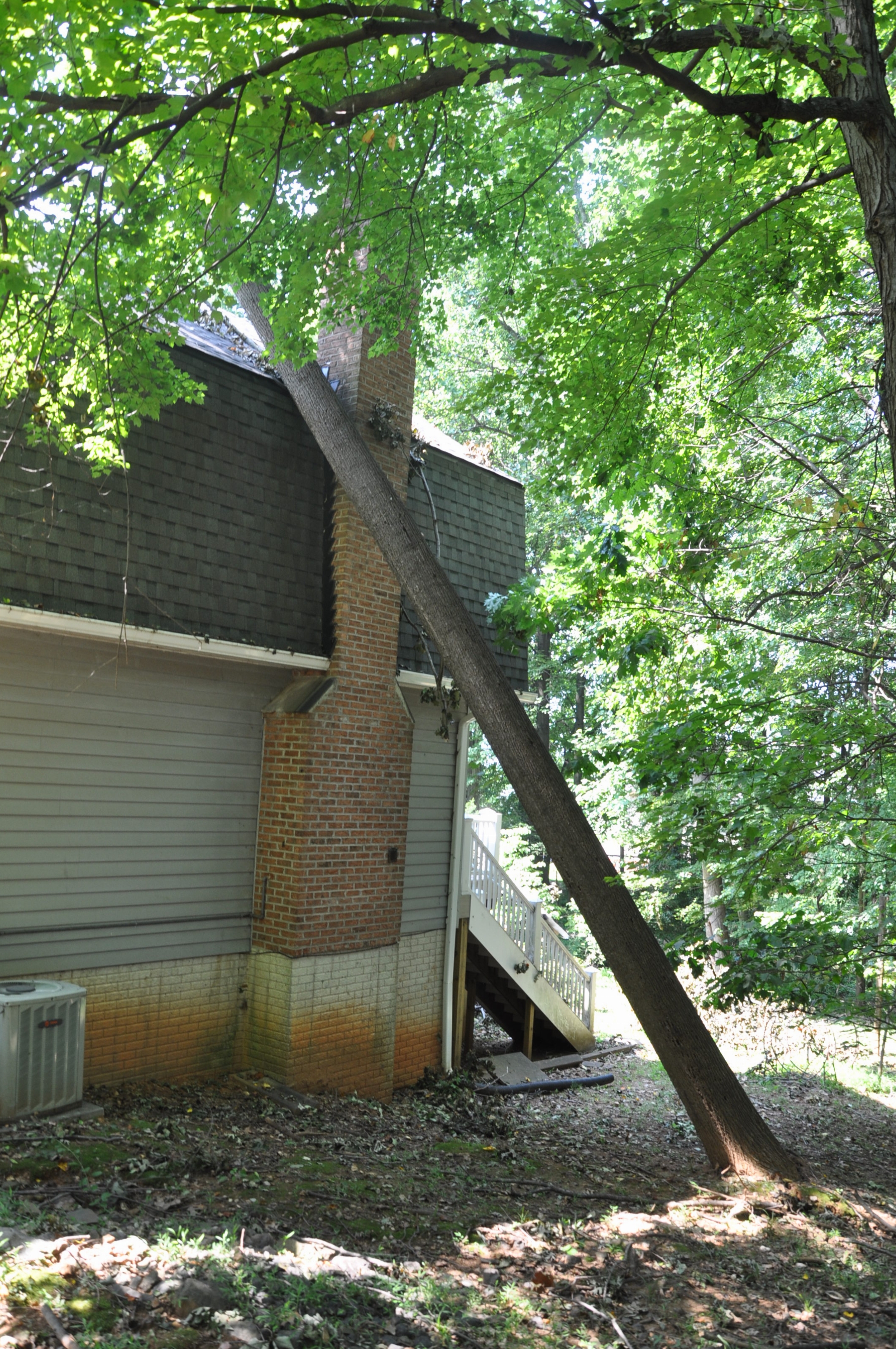
Before anyone talks about permits or crane access, the first question is whether removal is the right answer at all. Removal becomes the recommendation when a tree’s structure is compromised beyond what pruning or support systems can address: extensive decay at the base, a large crack through a codominant union, a new lean with heaving soil, or major root loss from construction. We covered the seven warning signs you can check from the ground in a recent article, and we have written separately about leaning trees in Rockville, which come up often in the city’s older neighborhoods.
This year adds a layer of context. Montgomery County ran roughly two and a half inches behind normal rainfall for January through September, according to Drought.gov, even though September itself came in slightly wet. Trees under moisture stress often show thin canopies, early fall color, or dieback at the branch tips. One dry year rarely kills an established, healthy tree, and a tree that looks rough this October may leaf out normally next spring. Thinning alone is a reason to monitor, not a reason to remove. Decay, cracks, and root problems are different, because they do not heal on their own.
What a Good Tree Service in Rockville, MD Will Recommend Instead
An honest estimate should tell you when a tree does not need to come out. Limbs over a roof are usually a clearance pruning job. Interior deadwood in an otherwise sound tree is crown cleaning. A weak but healthy union can sometimes be supported with a cabling system. Each of those options keeps a mature shade tree that is cooling your house in summer and intercepting stormwater, at a fraction of the cost of removal.
Timing differs between the two kinds of work. Removal of a tree that has to come out can happen any time of year, and dead or hazardous limbs can be taken off whenever they are found. Structural pruning on healthy trees is generally best done in late winter, from February through March, when the trees are fully dormant and the branch architecture is easy to read. If your fall estimate turns into a pruning recommendation, that is not a delay. It is the right work at the right time.
Why the Dormant Season Works Well for Removal This Year
Removing a deciduous tree after leaf drop means less weight and debris in the crown, a clear view of every union and crack, and less lasting damage to dormant lawns and beds underneath. Two factors specific to this fall are worth adding.
Nesting season is over. Most songbirds in the region finish nesting by late summer. Federal law protects active bird nests, meaning nests that hold eggs or chicks, and the U.S. Fish and Wildlife Service notes it is illegal to destroy one. Late fall and winter removal largely avoids that conflict, though crews should still check for cavity nests and roosting animals before cutting.
The winter outlook leans wet. On October 15, NOAA’s winter outlook pointed to a very strong El Niño and favored wetter-than-average conditions along the East Coast from December through February, with warmer-than-average temperatures across much of the East. NOAA does not forecast seasonal snowfall, and a warm, wet winter may bring more rain than snow. The practical point is modest: wet snow and ice add weight to limbs that are already compromised. If a tree with known structural problems is already on your list, the next few months are a reasonable window to handle it on your schedule rather than the weather’s.
What to Expect on Removal Day
A well-run removal is mostly planning. Here is what the process should look like from the homeowner’s side.
The estimate. Someone walks the property with you, looks at the tree, the targets around it (house, fence, driveway, power service), and the access route. You should leave with a written estimate that spells out the work, the cleanup, and whether the stump is included. In Maryland, tree work for hire must be performed under a Licensed Tree Expert, and the license number should appear on the estimate.
Approvals. If the tree is covered by a forest conservation plan, sits in a historic district, or falls under HOA review, approvals come before scheduling. The crew should also confirm the tree is not a city street tree.
Access and preparation. Expect to be asked to move vehicles, open gates, keep pets inside, and point out irrigation heads, invisible fencing, and septic or drainage lines. Crews use plywood or ground mats over lawns that are soft from fall rain.
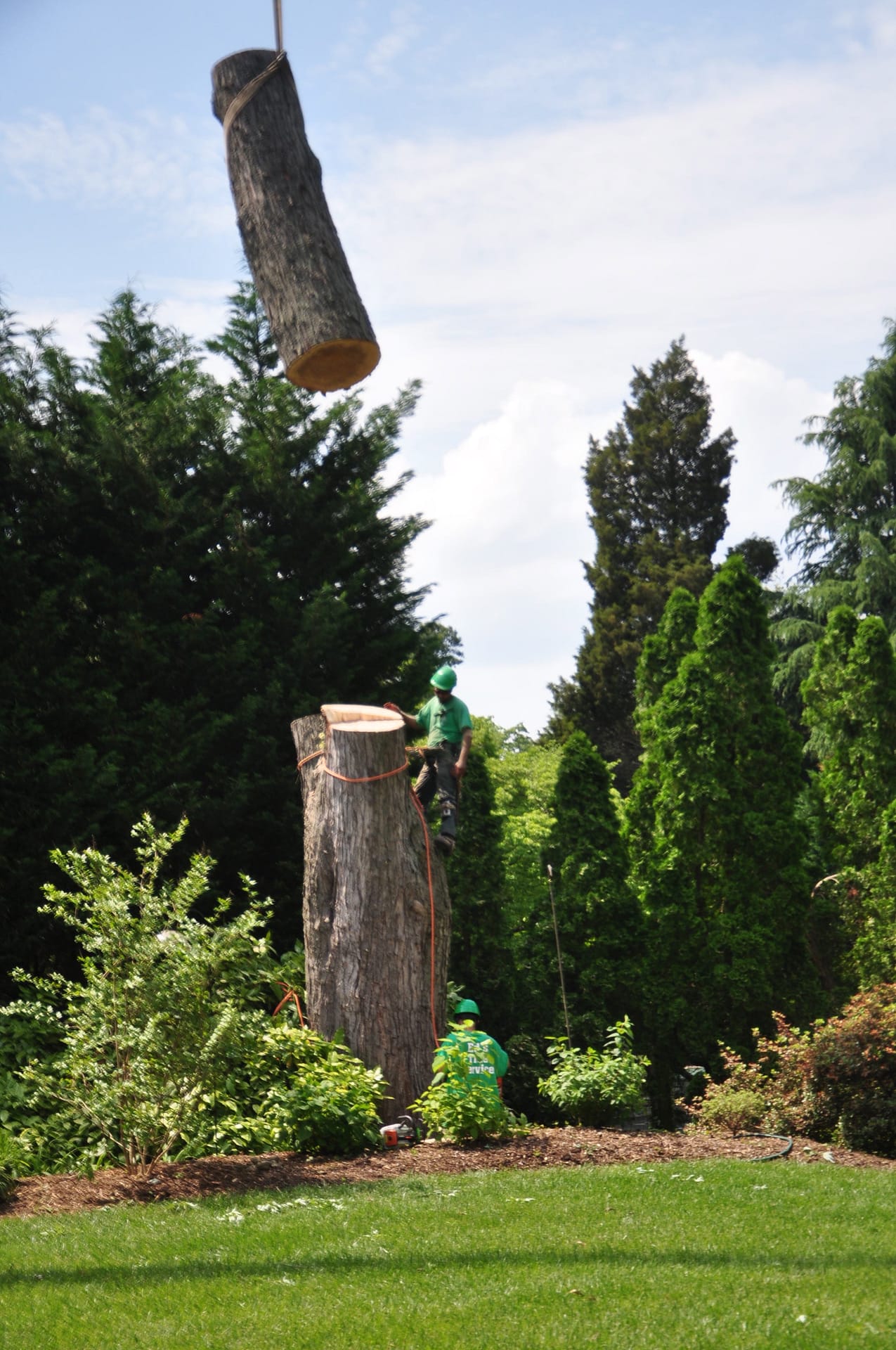
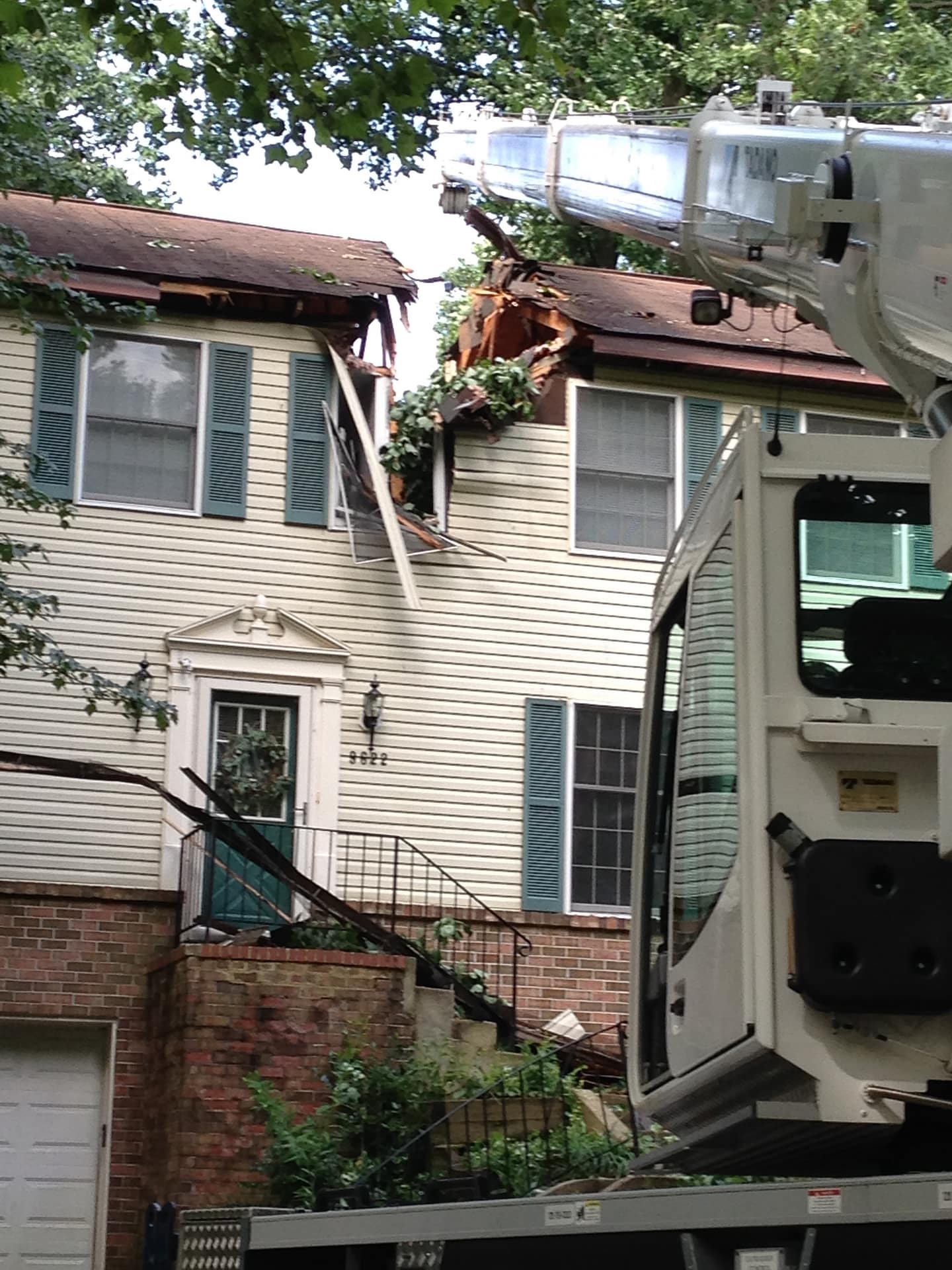
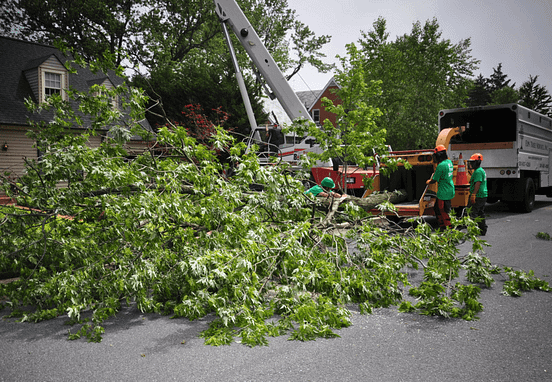
Taking the tree down. Few residential removals in Rockville involve felling a whole tree. Lots are tight and targets are close, so most trees come down in sections, lowered by rigging from a climber or worked from a bucket truck. Large trees over structures may call for a crane, which lifts sections out rather than lowering them through the yard.
Cleanup and the wood. A complete job hauls away the wood, branches, and debris and leaves the yard raked. If you want firewood, ask to have it cut and stacked. Keep that wood on your property or nearby. All of Maryland is under a state spotted lanternfly quarantine, and logs, stumps, firewood, and yard waste are regulated articles. Businesses moving them need a state permit, and homeowners should avoid hauling wood out of the area.
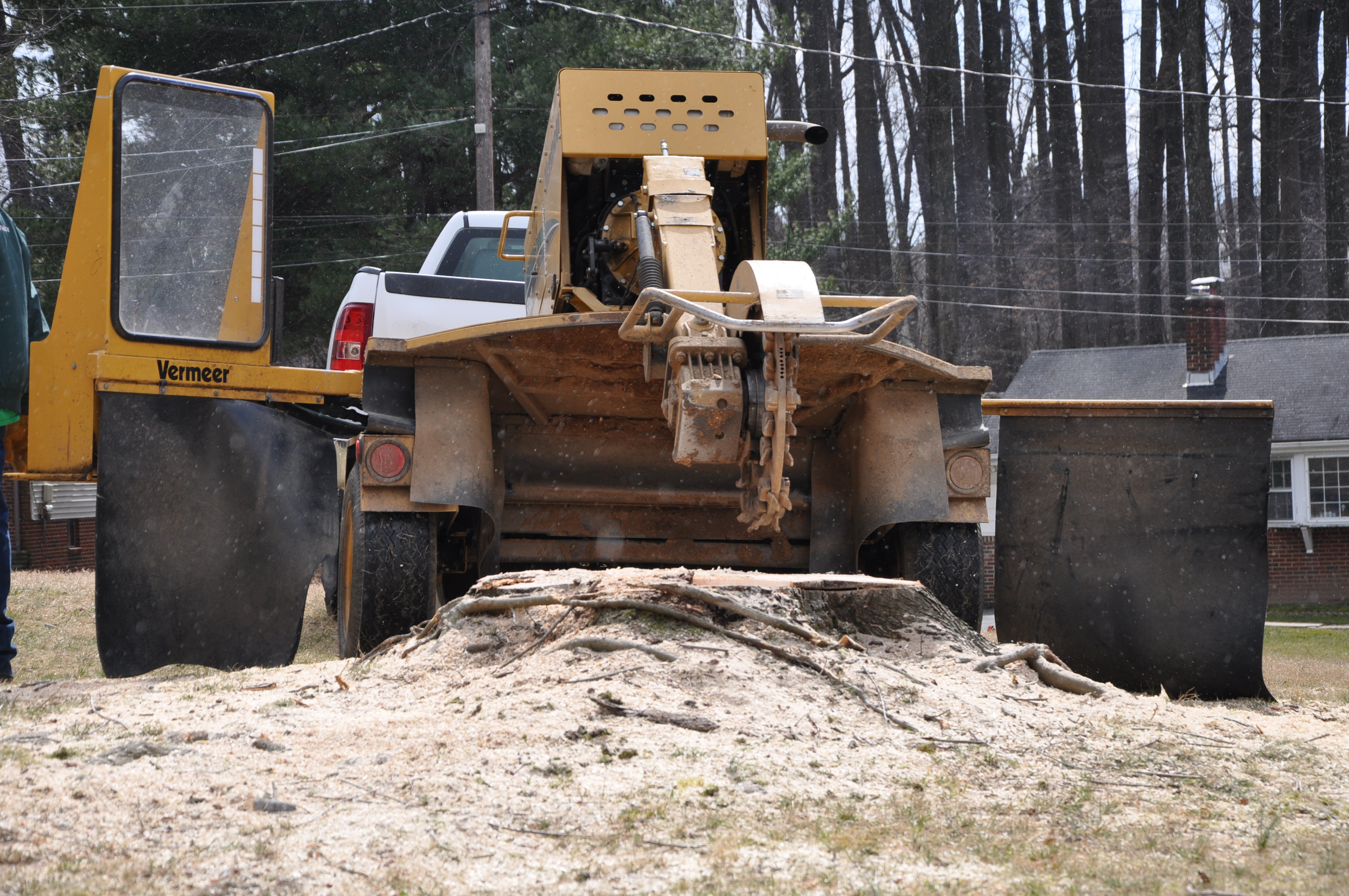
The stump. Stump grinding is often cheapest when it is done in the same visit as the removal, since getting equipment to the property is a large share of the cost. Underground utilities should be marked through Miss Utility (811) before grinding below grade.
Keep removal debris out of the leaf piles
Rockville’s fall vacuum leaf collection runs by area through mid-December, and the city asks residents to remove sticks and other debris from leaf piles because they damage the equipment. Leaves go next to, not into, the roadway and gutters, and should not be bagged in plastic. If a removal or pruning job is scheduled near your collection week, make sure the crew takes all woody debris with them. Here is the 2026 fall schedule:
- Area 4: Oct. 12 to 16 and Nov. 16 to 20
- Area 5: Oct. 19 to 23 and Nov. 23 to 27
- Area 1: Oct. 26 to 30 and Nov. 30 to Dec. 4
- Area 2: Nov. 2 to 6 and Dec. 7 to 11
- Area 3: Nov. 9 to 13 and Dec. 14 to 18
Leaves should be at the curb by 6 a.m. on the first day of your area’s window, and not more than a week early.
Quick Reference: Who Decides on a Rockville Tree
- Tree on a single-family lot with no forest conservation plan: your decision, plus your HOA if you have one. No city permit under the FTPO.
- Tree covered by an existing Forest Conservation Plan: the City Forestry Official reviews it. Replacement or fee in lieu is possible.
- Townhouse common area, condo, commercial, or institutional property, tree 12 inches DBH or larger: a permit from the City Forestry Official is required, with replacement scaled to trunk size.
- Historic district, tree 12 inches DBH or larger visible from the street: Historic District Commission review, with replacement by a similar species.
- Diseased or hazardous tree in a historic district: Chief of Planning approval with certification from a Maryland-certified arborist.
- Street tree in the public right-of-way: City of Rockville Forestry only. Residents and private contractors may not prune or remove it, so request a city inspection.
Planning a removal this fall? Ed’s Tree Service has worked in Rockville and across Montgomery County since 1987, and as a family-run Rockville tree removal company, we sort out which rules apply to your tree before any work is scheduled.
Our crews haul away the wood and debris and leave the yard raked, and estimates are free. Contact us today!
Key Takeaways
- Rockville has its own Forest and Tree Preservation Ordinance, separate from Montgomery County’s rules, and it was amended in January 2026.
- A significant tree is 12 inches or more in trunk diameter at breast height. Invasive species do not count.
- Trees on lots with an existing single-family home are generally exempt from the city’s removal permit, unless they are covered by a forest conservation plan or stand in the right-of-way.
- Townhouse common areas, condos, commercial properties, and historic districts face permit or HDC review, often with replacement planting.
- Street trees belong to the city. Residents and private contractors may not prune or remove them.
- Late fall and winter suit removal work, and nesting season is over. Structural pruning on healthy trees is best left for February and March.
- A good Rockville tree service will tell you when pruning or monitoring is the better answer.
Frequently Asked Questions
Do I need a permit for tree removal in Rockville, MD?
If the tree is on a lot with an existing single-family home, Rockville’s ordinance generally does not require a permit, even for large trees. A permit is required for significant trees (12 inches DBH or more) on other kinds of property, for trees covered by a forest conservation plan, and HDC review applies to larger trees in historic districts. Your HOA may have its own approval process. When in doubt, call the city’s Community Planning and Development Services department at 240-314-8200 before work starts.
Can I remove the street tree in front of my house?
No. Trees in the public right-of-way are maintained by the City of Rockville under Maryland’s Roadside Tree Law, and it is unlawful for residents or their contractors to prune or remove them. If a street tree looks dead or dangerous, request an inspection from Rockville Forestry at 240-314-8700 or through the city’s online form.
What should a tree removal company in Rockville handle for me?
At a minimum: a written estimate with the Maryland Licensed Tree Expert number on it, confirmation of whether any city, HDC, or HOA approval applies, proof of insurance, safe rigging or crane work, and full cleanup. Ask in advance whether stump grinding and firewood stacking are included so nothing is a surprise on the day.
Is tree removal in Rockville different from tree removal in Bethesda?
Yes, mostly in the paperwork. Bethesda is unincorporated, so tree removal in Bethesda follows Montgomery County rules only. Rockville layers its own ordinance on top, with its own definition of a significant tree, its own replacement requirements, and its own historic district review. For a single-family backyard tree, the practical outcome is often similar in both places. For HOAs, commercial properties, and historic homes, Rockville involves more steps.
Will the city pick up branches with my leaves?
No. Rockville’s vacuum leaf collection is for leaves only, and the city asks residents to remove sticks and debris from leaf piles because they damage the equipment. Branches and wood from tree work should leave with the crew.
How long does a typical residential removal take?
Most single-tree removals on a residential lot take a few hours to a full day, depending on the tree’s size, how close it is to the house, and whether a crane is needed. Approvals add time before the work, not during it, which is why it helps to start the process well before you want the tree gone.
Glossary
Diameter at breast height (DBH)
The standard way to measure a tree’s trunk, taken 4.5 feet above the ground. Rockville’s ordinance uses DBH to decide which trees are protected.
Invasive species
A non-native plant that spreads aggressively and displaces native vegetation. Invasive trees are not protected as significant trees in Rockville.
Public right-of-way
Land along a street owned or controlled by the government, usually including the strip between the sidewalk and the curb. Trees there are street trees.
Historic district
An area designated for its historic character, where changes visible from the street, including removal of larger trees, go through a review commission.
Dieback
Progressive death of twigs and branches, usually starting at the tips. It is a common response to drought, root damage, or disease.
Dormancy
The resting period when a deciduous tree has dropped its leaves and growth has stopped, generally from late fall through late winter in Maryland.
El Niño
A periodic warming of Pacific Ocean surface waters that shifts the jet stream and influences winter weather across the United States.
Bucket truck
A truck with a hydraulic boom and an enclosed platform that lifts a worker into the canopy.
Spotted lanternfly
An invasive planthopper now established in Maryland. The entire state is under quarantine, which restricts moving wood, firewood, and yard waste.
Stump grinding
Removing a stump by chipping it below the soil surface with a rotating cutting wheel, leaving the roots to decay naturally in place.