It usually happens at the worst possible time. A gust comes through overnight, there is a crack and a thud, and in the morning a large limb is lying across the roof or a whole tree is resting on the car in the driveway. If you have never needed emergency tree service in Rockville before, the hardest part is not knowing what comes next.
This article walks through what actually happens, from the moment you notice the damage to the moment the crew rakes up and leaves. It covers who to call first, what an emergency crew does when it arrives, why this kind of tree work is different from a planned removal, and how documentation for your insurance company fits in. We covered insurance coverage and permits in more detail in an earlier article, so this one stays focused on the job itself.
Why This Winter Is Worth Planning For
Most tree emergencies in Montgomery County come with wind, wet snow, or saturated ground. The Capital Weather Gang’s 2026 to 2027 winter outlook, published October 28, expects a mild winter with below-normal snow, roughly 8 to 16 inches for Montgomery County. It also expects total precipitation at 125 to 150 percent of normal, and it cites model data suggesting the odds of an extreme precipitation event are well above usual.
That combination matters for trees. Soaked soil holds roots less firmly, so a strong wind on wet ground is more likely to tip a tree over at the roots than it would be in dry weather. Heavy, wet snow loads branches that are already weak. None of this is a reason to worry about every tree in the yard. It is a reason to know the process before you need it.
Step 1: Make Sure Everyone Is Safe
Before anything else, get people out of harm’s way.
- Call 911 if anyone is hurt, if you smell gas, if there is fire or sparking, or if a tree has blocked a road in a way that puts drivers at risk.
- Stay away from any downed wire and anything it touches, including the tree, a fence, or a puddle. Assume every line is live.
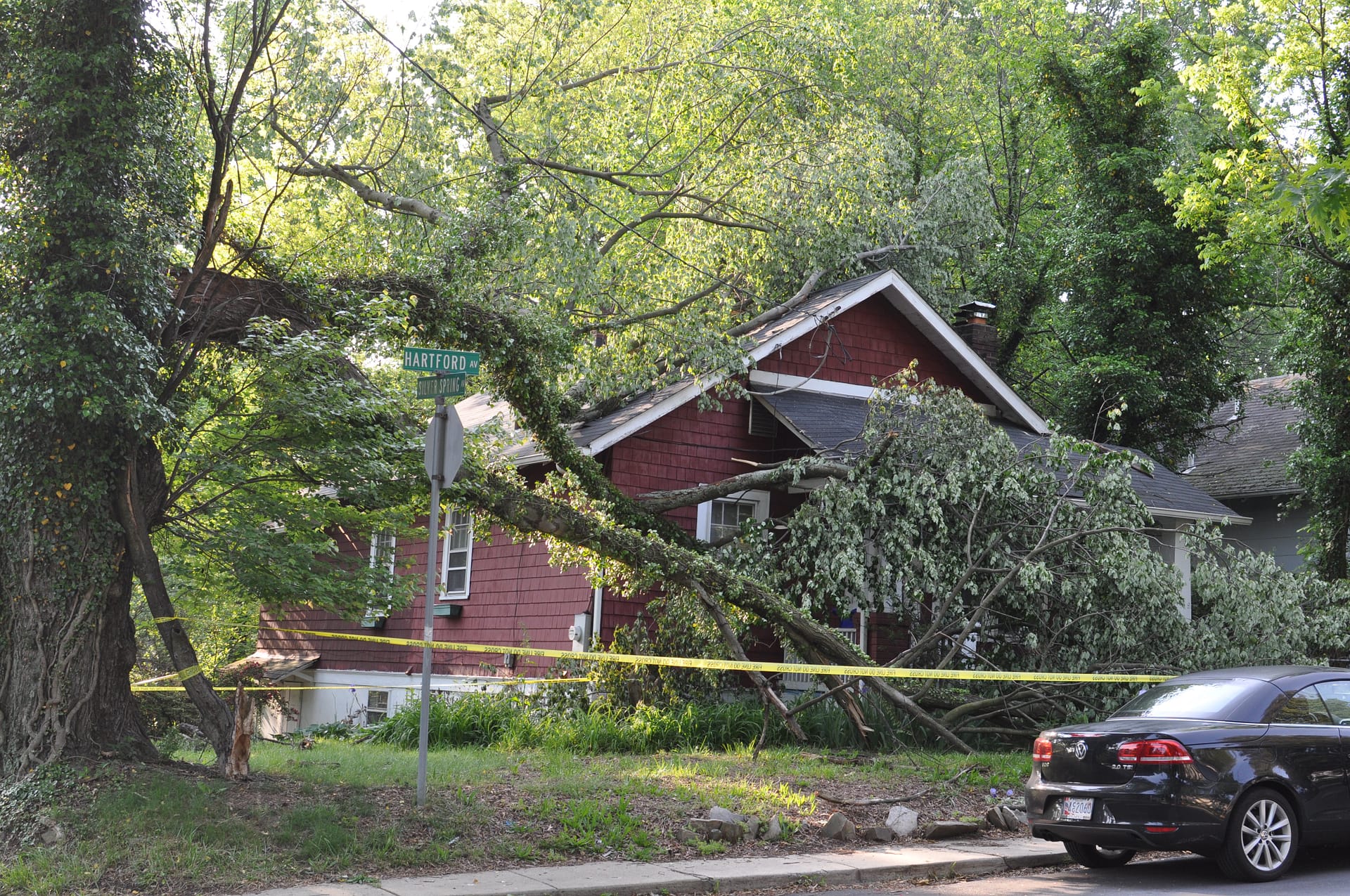
- Leave the room or the house if a tree has broken through the roof or is resting on the structure. Weight can shift without warning.
- Keep children and pets inside and away from the damaged area.
Do not try to cut, push, or pull a tree off a house, a car, or a line yourself. That is where most of the serious injuries in storm cleanup happen.
Step 2: Figure Out Whose Tree and Whose Line It Is
In Rockville, three different parties handle three different kinds of problems, and calling the right one first saves hours.
- Power lines go to Pepco. If a tree or limb is on or tangled in electrical lines, call Pepco’s emergency line at 1-877-737-2662. Tree crews cannot safely work on a tree that is touching an energized line. Work within 10 feet of utility lines is restricted to specially qualified line-clearance crews, so the utility has to make the line safe before a private crew can begin. Note that Pepco does not clear limbs from cable and phone lines, which belong to those providers.
- City trees go to the City of Rockville. Trees in the public right-of-way, usually the strip between the sidewalk and the street, and trees on city property belong to the city. Report them through the city’s damaged or fallen tree form, by calling Rockville Forestry at 240-314-8700 on weekdays from 7 a.m. to 3 p.m., or at 240-314-8900 after hours. Private contractors are not allowed to remove city trees, even in an emergency. If you are unsure where your property line is, our earlier article on Rockville’s tree rules explains how to tell.
- Your own trees go to an emergency tree service. If the tree is on your property and no energized line is involved, or once Pepco has cleared the line, call a licensed emergency crew directly.
Step 3: The Call, and What You Will Be Asked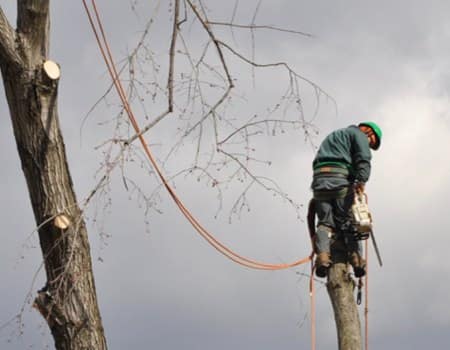
A good emergency dispatcher asks questions that shape the response before anyone gets in a truck. Expect to be asked:
- Where the tree or limb is, and what it is resting on: roof, car, fence, deck, or open lawn
- Whether any lines are involved and whether Pepco has been called
- Whether anyone is still inside the house, and whether the roof is open to the weather
- Roughly how big the tree is and what kind it is, if you know
- How a truck can reach it: driveway width, gates, overhead wires, parked cars
Photos texted or emailed at this stage help a crew bring the right equipment the first time. A tree on a roof may call for a crane. A limb across a back fence may need nothing more than a climber, ropes, and a chipper.
Step 4: Emergency Tree Work in Rockville Looks Different from a Planned Removal
When the crew arrives, the first job is not cutting. It is reading the tree. This is the part of Emergency Tree Work in Rockville that homeowners rarely see but that determines whether the job goes safely.
A tree that has fallen on something is no longer a tree in the normal sense. It is a load. Parts of the trunk and limbs are bent under tension, stretched like a drawn bow, while other parts are under compression, squeezed together. Cut a tensioned piece in the wrong place and it can spring free with enough force to injure someone. Arborists call a bent sapling or limb held under tension a spring pole, and storm damage is full of them.
The crew will work out:
- Where the tree’s weight is actually resting, and what is holding it up
- Which parts are under tension and which are under compression
- What will move, and in which direction, when each piece is cut
- Whether the house, the deck, or the car underneath needs support before any weight comes off
If a trunk is resting on a roof, the crew may install temporary supports so the weight does not shift onto weaker framing as pieces are removed. If the roof is open, the crew can tarp it to keep rain and snow out until a roofer arrives.
Step 5: Taking the Tree Off
Once the plan is set, the tree comes down in pieces, almost never all at once.
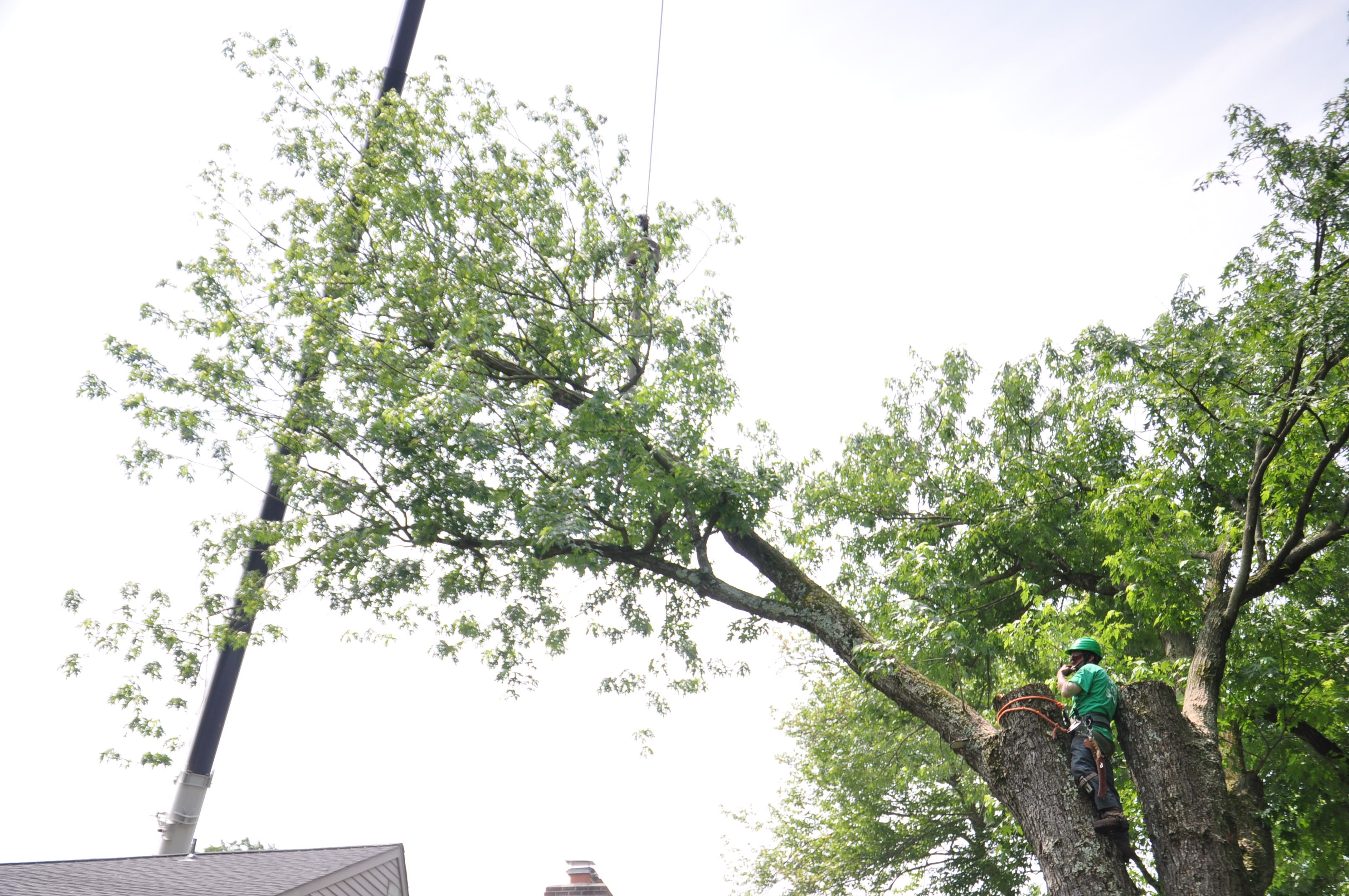
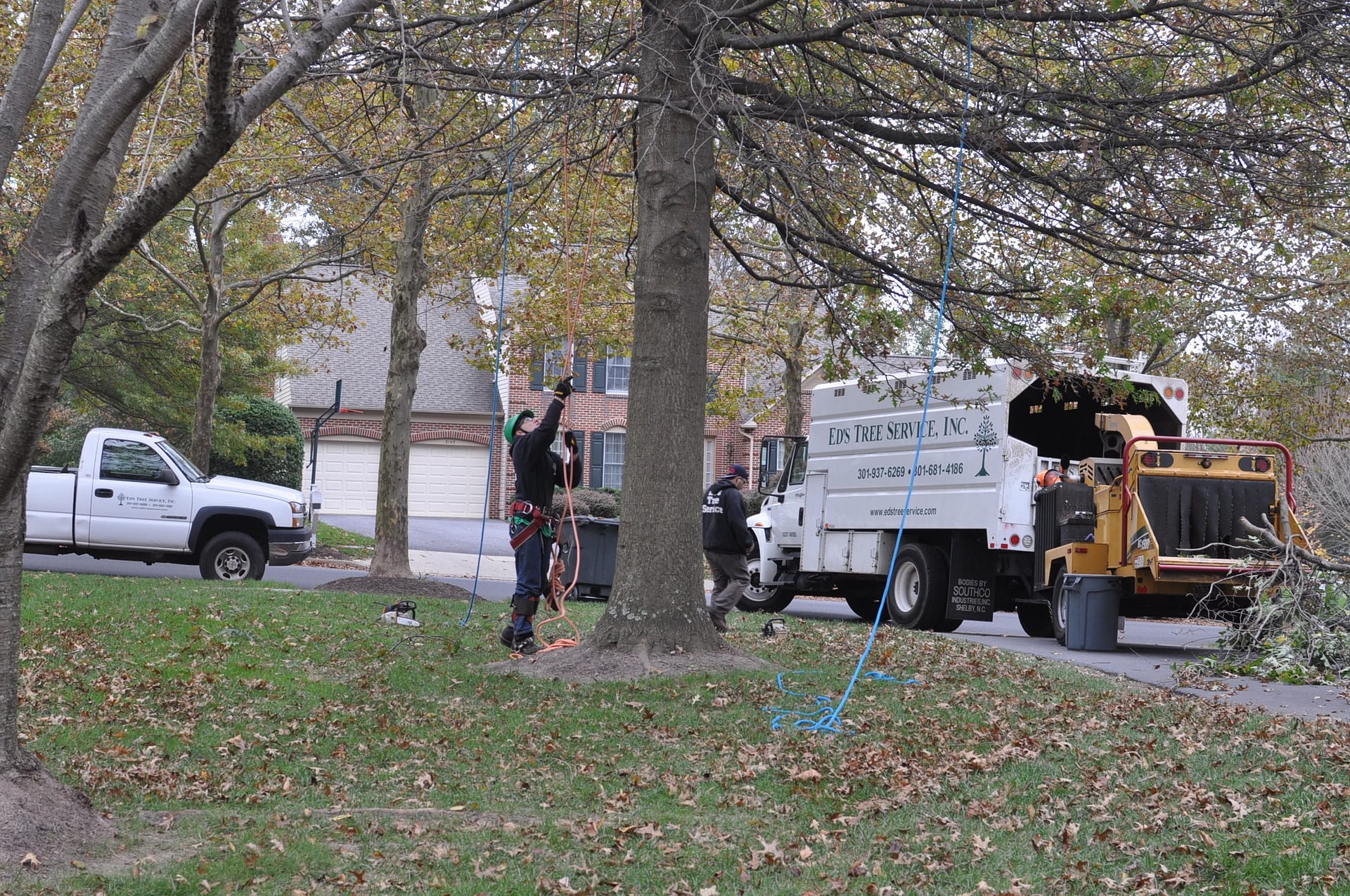
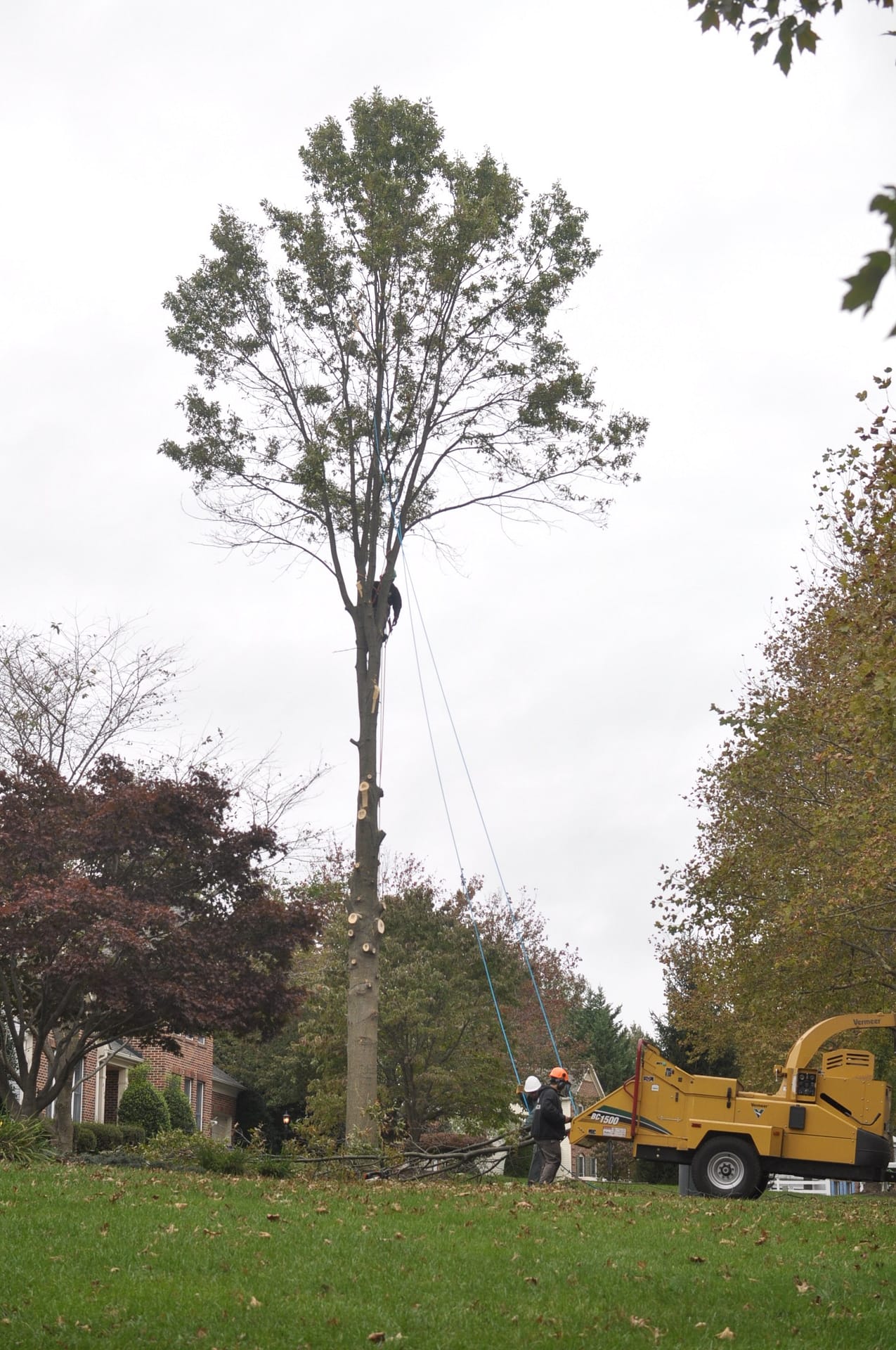
Rigging. Climbers or a bucket truck work from the top and the outer limbs inward. Each section is tied off with ropes and lowered under control rather than dropped.
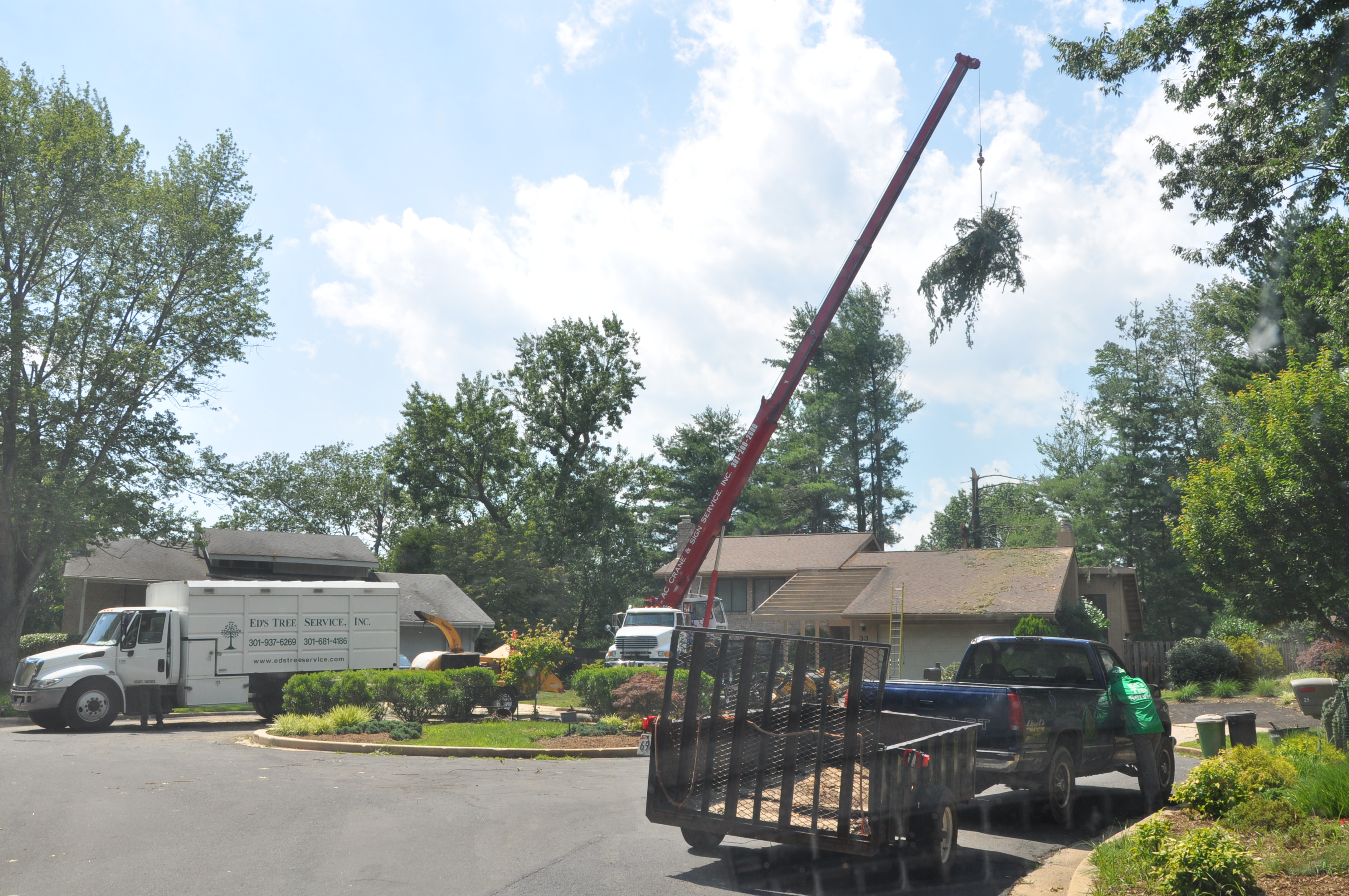
Crane-assisted removal. When a large trunk is lying on a house, a crane is often the safest and least damaging option. The crane takes the weight first, then each section is cut free and lifted straight up and away. Lifting vertically keeps the tree from being dragged across shingles, gutters, and siding.
Working the ground. Once the weight is off the structure, the crew cuts the rest into manageable pieces, chips the brush, and moves the wood to the truck or to wherever you have asked for it to be stacked.
The root plate of a tree that tipped over can be under tension too. A large root ball can rock back toward its hole when the trunk is cut free, which is one more reason to keep people well back until the crew says the area is clear.
Step 6: Documentation for Your Insurance Company
Insurance claims go more smoothly with good records. Before and during the work, a professional crew should photograph the tree, what it hit, and the damage underneath. Ed’s Tree Service documents damage for insurance claims and can bill many insurance companies directly, which keeps the cost off your credit card while the claim is processed.
The Maryland Insurance Administration recommends reporting property damage to your insurer as soon as possible, keeping a record of everyone you speak with, and getting more than one bid for repairs. It also points out that Maryland law prohibits contractors and roofers from offering to waive your deductible or promising a rebate on it. A company that offers to “cover your deductible” is a red flag.
Storms also bring out-of-area crews knocking on doors. Maryland DNR advises homeowners to verify a contractor’s credentials, including the Maryland Licensed Tree Expert license number, before agreeing to any work, and never to pay in full before the job is done.
Step 7: Cleanup and What Comes After
When the tree is off and the area is safe, the crew hauls away the brush and debris and rakes the yard. A few follow-up decisions usually remain.
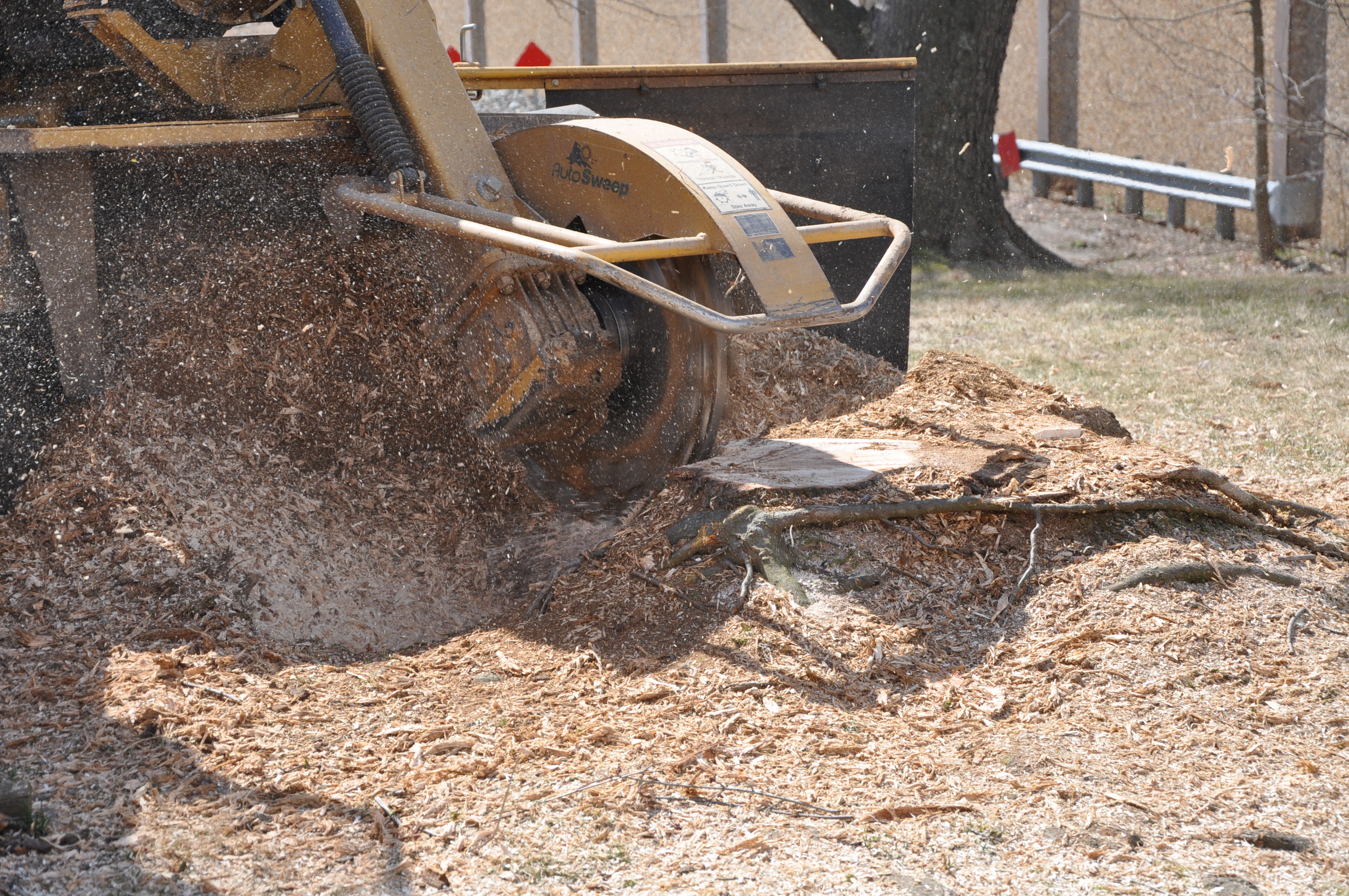
- The stump. Emergency work focuses on getting the tree off the structure. Stump grinding can be scheduled afterward, once underground utilities have been marked.
- The wood. Ask whether you want firewood cut and stacked. All of Maryland is under a spotted lanternfly quarantine, so keep firewood on your property rather than hauling it elsewhere.
- Structural repairs. The roofer, contractor, or auto body shop comes next. A tarp from the tree crew holds things until then.
- The other trees. A storm that brought down one tree may have cracked or loosened others nearby. Ask the crew to look at neighboring trees, especially ones that share the same soil and exposure.
What Not to Do While You Wait
- Do not climb onto the roof to inspect the damage.
- Do not start a chainsaw on a tree that is resting on anything, or on any limb that is bent or under strain.
- Do not approach or try to move a line, even one you believe is a cable or phone line.
- Do not sign a contract on the spot with a crew you have never heard of, or with anyone who cannot give you a Maryland tree expert license number.
- Do not throw away damaged property before the insurance adjuster has seen it or photos have been taken.
How to Lower the Odds of Needing a Crew at All
Not every tree emergency can be prevented, but many fallen limbs give warnings long before they fail: dead branches, cracks at a fork, mushrooms at the base, or a new lean. Late fall and winter are a good time to have those looked at. Dead and broken limbs can come out any time of year, and structural work on healthy trees fits well into dormant-season pruning from February through March. Removing a weak limb on a calm Tuesday costs far less, in money and stress, than removing it from your roof after a storm.