The first frost advisories of the season reached Maryland this month. On October 18, northwestern Montgomery and Howard counties were under a frost advisory and Frederick County had a freeze warning, and another advisory covered many suburbs west of I-95 on October 26, according to the Capital Weather Gang. As the leaves come down, homeowners start noticing the dead limb over the driveway, the branch scraping the gutter, and the young maple that has grown lopsided. The natural question is whether now is the time for tree pruning in Maryland. The honest answer is that some pruning belongs right now and some is better a few months from now. Knowing the difference protects your trees and your property, and it means the work you schedule this fall is the work that does the most good. This article explains how cold weather changes a tree’s response to pruning, what to prune before winter, what to save for full dormancy, and what good Maryland tree pruning looks like on the day it happens.
MD Tree Pruning That Makes Sense Right Now
Late fall is the right time for pruning that removes hazards and dead wood, because none of it depends on the tree’s growth cycle.
- Deadwood removal. UNH Extension notes that removing deadwood does not affect the tree as long as the cut does not go into live tissue. Late October is also a good moment to find it. While some leaves are still on, dead limbs stand out as bare branches against live ones. Once everything is leafless, dead wood is harder to tell apart from the ground.
- Broken and hanging limbs. Branches cracked by summer storms, or “hangers” lodged in the canopy, can come down without warning, especially under the first wet snow. These should be removed whenever they are found.
- Clearance over roofs, gutters, and driveways. Limbs resting on a roof or hanging low over a driveway take on extra weight from snow and ice. Clearing them before winter is targeted, practical work. Lines running between poles, or the service line to your house, are a job for the utility or for qualified line-clearance workers, not for a homeowner with a pole saw.
- Diseased branches. Small, cleanly cut removals of clearly diseased wood are fine. Keep wounds small and sanitize tools between cuts.
If you are already thinking about winter storms, our winter storm preparation guide covers how ice and snow load branches and which defects tend to fail first.
Pruning Worth Saving for Full Dormancy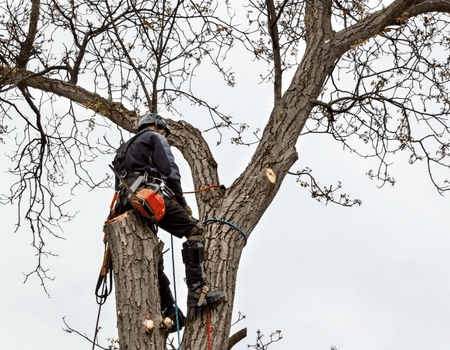
Most pruning of healthy, living wood is better done once trees are fully dormant, and for many species late winter is the sweet spot. University of Maryland Extension’s Pruning 101 calls February to early March the ideal time to prune many trees, and that matches the schedule we follow for most structural work. With the canopy bare, every branch union is visible, insects and disease are quiet, and wounds begin closing as soon as spring growth starts.
Work to plan for that window includes:
- Structural pruning on young trees, which sets up a strong central leader and well-spaced branches while cuts are still small.
- Crown thinning, which selectively removes live branches to reduce weight and wind resistance.
- Crown raising, which lifts the lower canopy for clearance over lawns, walks, and views.
- Crown reduction, which shortens the overall height or spread by cutting back to well-placed lateral branches.
A few species deserve special mention.
- Oaks. Oak wilt is a serious fungal disease spread in part by sap-feeding beetles drawn to fresh wounds. According to University of Maryland Extension, it has so far been detected only in a small, localized area of western Maryland. Because the beetles are active in the warm months, Iowa State Extension advises not pruning oaks from March through October, and we treat the dormant season as the preferred window for oaks across our service area as a precaution. For the large white, red, and pin oaks shading older neighborhoods from Bethesda to Silver Spring, that makes the coming winter the right time for planned oak pruning.
- Maples, birches, and elms. These species bleed sap heavily when pruned in late winter and early spring. Some homeowners find it alarming. Iowa State notes that early summer, after leaves fully expand, is an alternative for these trees.
- Spring-flowering trees. Cherries, redbuds, dogwoods, and magnolias set their flower buds the previous year, so winter pruning removes some of next spring’s bloom. If flowers matter most, light shaping right after bloom is an option. Structural corrections can still happen in winter.
- Winter-damaged evergreens. If hollies, rhododendrons, or other evergreens brown over the winter, wait until new growth appears in spring before pruning. Buds behind scorched foliage are often still alive.
For a broader look at timing across the full year, our earlier article on six things homeowners should know about pruning covers the basics.
What Professional Tree Pruning in Maryland Should Look Like
Good timing does not help much if the cuts are wrong. These are the practices that separate proper pruning from work that harms a tree.
- Cuts at the branch collar. The branch collar is the slightly swollen ring of tissue where a branch joins the trunk or a larger limb. A cut just outside it lets the tree seal the wound properly. A flush cut into the collar removes the very tissue the tree needs to close the wound. A long stub left behind tends to die back and decay.
- The three-cut method for heavy limbs. A large branch cut in a single pass will tear bark down the trunk as it falls. The first cut goes partway up from the underside, a short distance out from the collar. The second cut, from the top and slightly farther out, drops the limb’s weight. The third cut removes the remaining stub at the collar.
- No wound paint. University of Maryland Extension’s Master Gardener guidance on pruning do’s and don’ts is clear that sealants are not needed in most cases, because trees isolate wounds on their own.
- Restraint with live wood. The same UMD guidance advises removing no more than about a quarter of a tree’s live branches. Our own practice caps crown thinning at 25 percent of the canopy. Removing more stresses the tree and often triggers a flush of weak, fast-growing sprouts.
- Never topping. Topping cuts main branches back to stubs without regard to branch structure. It leads to decay and weakly attached regrowth that is more likely to fail later. A tree that is too big for its space should be reduced with proper cuts to lateral branches, or evaluated honestly for tree removal if reduction cannot solve the problem.
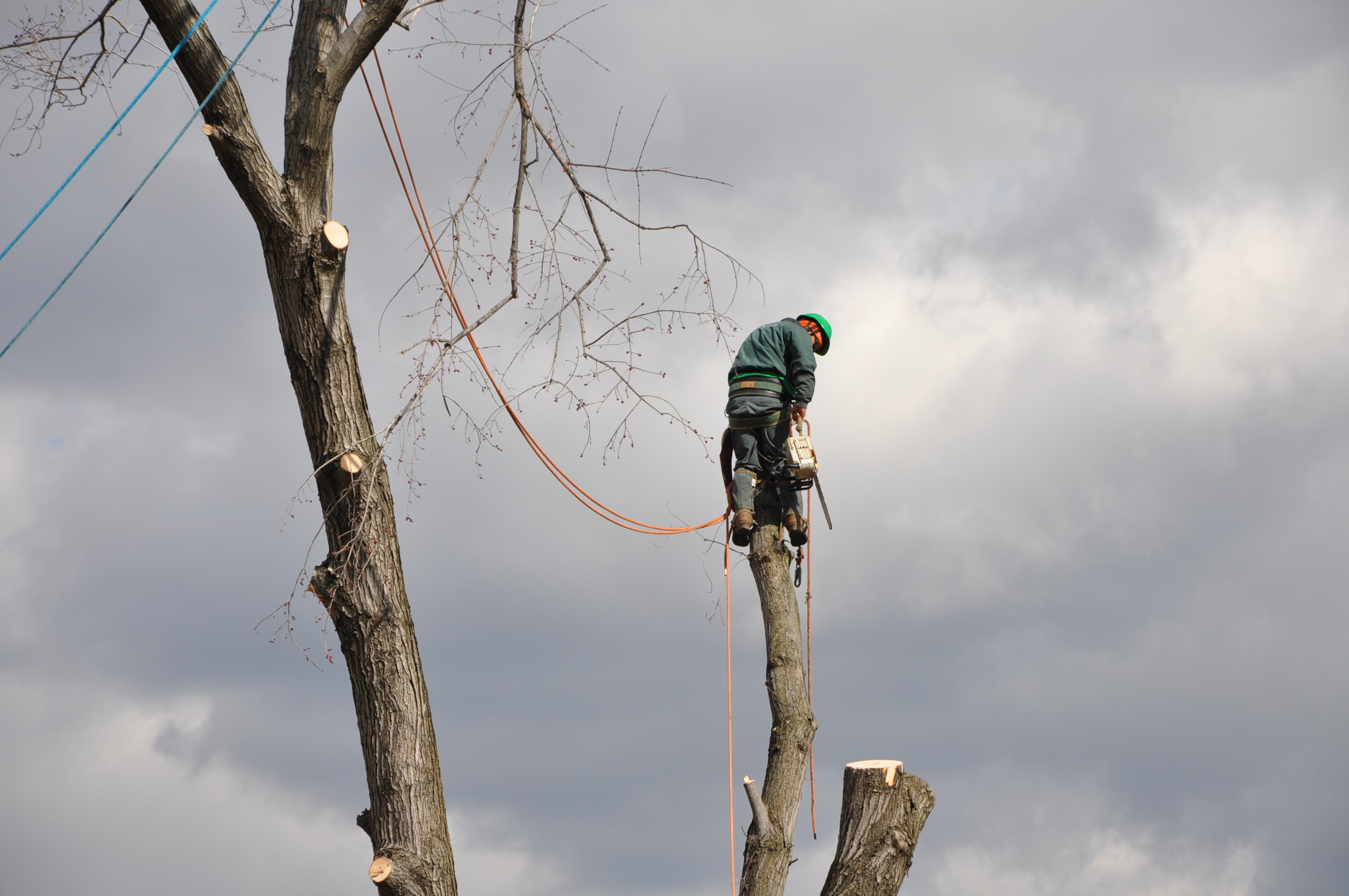
- No climbing spurs on trees that are staying. Spurs puncture living bark. Climbers pruning a healthy tree should work from ropes or an aerial lift, not spikes.
What You Can Prune Yourself, and When to Call a Pro
A lot of small pruning is good homeowner work. Dead twigs, small crossing branches, and suckers on young trees can be handled from the ground with clean, sharp hand pruners, loppers, or a pole pruner. Make your cuts just outside the branch collar, and work on a dry day.
University of Maryland Extension recommends leaving large trees, any work that requires climbing, and anything near power lines to licensed tree experts or certified arborists. In Maryland, anyone paid to prune or remove trees 20 feet or taller must hold a state Licensed Tree Expert license, or work under someone who does. Cold weather adds its own risks: frozen bark, icy ladders, and brittle wood make winter climbing and chainsaw work more dangerous for anyone without the right equipment and training.
Cold-Weather Signs a Tree Needs Pruning Attention
Leaf drop is the easiest time of year to look up and take stock. Walk your property and watch for:
- Dead limbs with no buds, peeling bark, or fungal growth
- Broken branches hanging in the canopy
- Limbs resting on the roof, gutters, or siding
- Low branches over driveways and walks that will sag under snow
- Branches rubbing against each other, leaving open wounds
- Two large stems of similar size forking from the same point, especially with bark pinched between them
- A young tree growing lopsided or with competing leaders
The first four are candidates for work now. The last three are usually structural pruning to plan for late winter. Mushrooms or conks at the base, deep cracks, or a new lean call for a full assessment rather than pruning alone. Our article on warning signs you can check from the ground covers those in more detail.
A Seasonal Pruning Calendar for Maryland
Late October through November (leaf drop)
- Remove deadwood, broken limbs, and hangers.
- Clear limbs off roofs, gutters, and driveways before snow and ice.
- Walk the property and schedule winter structural work.
December and January (dormant)
- Planned pruning on oaks once they are fully dormant.
- Larger structural and reduction work on mild, dry days.
February and March (late dormant)
- The ideal window for structural pruning, thinning, and raising on most deciduous trees.
- Expect heavy sap flow from maples and birches pruned in this window.
After spring bloom
- Light shaping on cherries, redbuds, dogwoods, and magnolias.
- Prune winter-browned evergreens once new growth shows what is alive.
Any time of year
- Storm damage, dead wood, and hazardous limbs.
Ed’s Tree Service has provided Maryland tree pruning since 1987, with proper cuts at the branch collar, the three-cut method on heavy limbs, and no topping, ever. If you have dead limbs to clear before winter or want to get on the schedule for dormant-season pruning, our family-run team will walk the property with you. Contact us today.
Frequently Asked Questions
Is it okay to prune trees in the fall in Maryland?
Yes, for the right kind of work. Removing dead, broken, and hazardous branches is fine any time, and late fall is a practical time to clear limbs off roofs and driveways before winter. Routine pruning of healthy live wood is better left until trees are fully dormant, because wounds close slowly in cool weather and decay fungi are active during leaf drop.
When is the best time for tree pruning in Maryland?
For most deciduous trees, late winter, from February through early March, is ideal. Trees are fully dormant, branch structure is easy to see, and wounds begin closing quickly once spring growth starts. Spring-flowering trees can be lightly shaped after they bloom, and dead or damaged wood can come out whenever it is found.
Should I prune my oak tree in winter?
Winter is the preferred time. Oak wilt, a fungal disease spread in part by beetles attracted to fresh wounds, has been detected in a small area of western Maryland. Pruning oaks during the dormant season, when those beetles are inactive, is a sensible precaution anywhere in the state. If an oak has a broken or hazardous limb during the warm months, it should still be removed for safety.
Does pruning help prevent winter storm damage?
It helps, though no pruning makes a tree storm-proof. Removing dead wood, cracked limbs, and branches resting on structures takes away the parts most likely to fail under snow and ice. Structural pruning over several years builds a stronger tree that sheds wind and weight more evenly. Over-thinning or topping does the opposite.
What does professional tree pruning in Maryland include?
A professional job starts with an assessment of the tree’s structure and health, then uses proper cuts at the branch collar, the three-cut method for heavy limbs, and restraint with live wood. It should never include topping or climbing spurs on a tree that is staying. In Maryland, paid tree work on trees 20 feet and taller must be done under a state Licensed Tree Expert, and a good company will haul away all debris when the work is finished.
Should I seal pruning cuts with tree paint?
No, in most cases. University of Maryland Extension advises against pruning sealants, because trees wall off wounds on their own and sealants can trap moisture and slow that process. A clean cut in the right place does more for the tree than any coating.
Glossary
Cold hardening
The process trees go through in fall to tolerate freezing, triggered by shorter days and cooler nights.
Dormancy
The resting period when trees stop active growth, generally from late fall through late winter in Maryland.
Compartmentalization
How a tree responds to a wound by walling off the damaged area to limit the spread of decay, rather than healing it.
Structural pruning
Pruning, usually on young trees, that guides growth toward a single strong leader and well-spaced, well-attached branches.
Branch collar
The slightly swollen ring of tissue where a branch joins the trunk. Cutting just outside it lets the tree seal the wound.
Topping
Cutting main branches back to stubs without regard to structure. It causes decay and weak regrowth and is rejected by professional standards.
Oak wilt
A fungal disease of oaks spread through root connections and by sap-feeding beetles drawn to fresh wounds. It has been found in a small area of western Maryland.