Fall is when a lot of Maryland trees come down. Dead and declining trees get removed before winter, storms take out a few more, and by November many yards have a fresh stump where a tree used to be. Some homeowners leave it, some want it gone right away, and many are not sure what their options are. This article explains how Maryland stump removal works, why a stump can cause more trouble than it seems, and what to expect before, during, and after the job.
How A Stump Removal in Maryland Can Help Your Home
A stump left in the ground does not just sit there. Over the years it decays, and that process brings a few predictable problems.
- Tripping and mowing hazards. A stump cut a few inches above ground is easy to catch with a mower blade or a foot, especially once leaves cover it. Surface roots spreading from it make the problem worse.
- Insects. Decaying wood attracts termites and carpenter ants. A stump near the house gives them a food source close to your foundation.
- Fungi. If you see clusters of honey-colored mushrooms around an old stump this fall, they may be a sign of Armillaria root rot. According to University of Minnesota Extension, the fungus can survive for many years in an old stump and its roots and spread through black, shoestring-like strands that can travel up to 10 feet to reach the roots of healthy trees. UMN’s advice for infected trees is to remove the stump and as many roots as possible.
- Sprouts. Many trees try to grow back. Oaks, maples, sycamores, and willows can send up new shoots from the stump or roots after the trunk is cut. Some species are far more aggressive. Penn State Extension notes that cutting tree-of-heaven causes it to send up vigorous stump and root sprouts, with root suckers appearing as far as 50 feet from the parent tree. That matters in Maryland, because tree-of-heaven is a preferred host for spotted lanternfly.
- Lost space. A stump takes up room you may want for lawn, a garden bed, a patio, or a replacement tree. A stump can take years to decay on its own, and the ground over it keeps settling the whole time.
Stump Removal vs. Stump Grinding in Maryland
Stump removal can mean two different jobs, and it helps to know which one you are asking for.
- Stump grinding is what most homeowners need. A stump grinder uses a rotating wheel lined with carbide teeth to chip the stump away below ground level. Ed’s Tree Service grinds stumps 4 to 12 inches below the surface, depending on what you plan to do with the spot. The visible stump and the upper root flare are gone, and the remaining roots underground break down naturally over time.
- Full stump extraction means digging out the stump and the main root mass. It takes heavy equipment, leaves a large hole, and disturbs much more of the yard. It is usually reserved for situations like new construction or foundations, where buried wood cannot be left behind.
For lawns, beds, and most replanting, grinding is faster, less disruptive, and less expensive than extraction.
What Happens on Grinding Day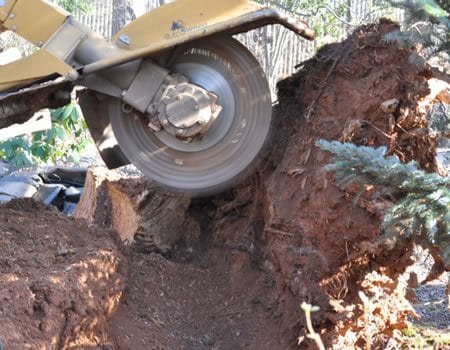
- Assessment. The crew looks at the stump’s diameter, the species, nearby structures, and how to get equipment to it. Large stumps in open front yards may get a truck-mounted grinder. Backyard stumps behind a fence are usually handled with a compact machine that fits through a standard gate.
- Utility marking. Grinding goes below ground, so buried lines matter. In Maryland, the law requires anyone digging to contact Miss Utility first, and when you hire a contractor, the Miss Utility homeowner guidance makes clear that the hired company is responsible for following those steps. Utility companies mark their own lines, but they do not mark private lines on your property. Point out irrigation lines, invisible pet fencing, landscape lighting, and any buried cable you know about before the work begins.
- Grinding. The operator sweeps the cutting wheel back and forth across the stump, lowering it a little at a time until the wood is below the target depth. Large surface roots that run out across the lawn can be ground at the same time if you want them gone.
- Cleanup. Grinding produces a surprising volume of wood chips, often more than the stump seemed to hold. You can keep them or have them hauled away.
What a Good Stump Removal Service in Maryland Does with the Leftover Chips
The chips left after grinding are useful, but not everywhere.
As mulch, they work well. Spread in a thin layer over beds or around trees, grindings break down slowly and feed the soil.
Mixed into soil, they can cause trouble. Purdue Extension explains that stump grindings have a high carbon-to-nitrogen ratio. As soil microbes break them down, they draw nitrogen from the surrounding soil, which can leave new grass or plants pale and underfed. The ground over a ground-out stump also settles as the buried wood decays.
If you plan to seed, sod, or plant in the same spot, the better approach is to remove most of the grindings, fill the hole with good topsoil, and mound it slightly to allow for settling. Ed’s Tree Service can haul the chips and bring in topsoil and seed for an additional charge. For more on handling the chips, see our earlier article on what happens to the wood chips.
Can You Replant A Tree After A Stump Removal
Many homeowners want a new tree after an old one comes out. A few guidelines help it get established.
- Plant a few feet to the side of the old stump rather than directly on top of it. The soil there is undisturbed and free of buried wood.
- If the old tree had Armillaria, choose a spot well away from the old root zone, and consider asking an arborist about species that tolerate the fungus better.
- Replace grindings with topsoil if you are planting grass or a small bed where the stump was.
- Watch for sprouts the following spring and pull or cut them as they appear.
Is Stump Grinding in MD Enough?
Grinding removes the stump, but some species keep trying to regrow from roots left in the soil. University of Arizona Cooperative Extension’s guide to stump sprouts and root suckers notes that grinding works well on species that do not resprout from large root fragments, while strong root-suckering species such as tree-of-heaven, black locust, and honey locust may need follow-up. Those sprouts can be cut repeatedly or treated, depending on the species and location.
One caution: sprouts sometimes come from the roots of a neighboring tree you want to keep. The same Arizona guide warns never to apply herbicide to suckers connected to a tree you plan to keep, because the chemical can travel through the shared root system.
Can You Remove a Tree Stump Yourself?
Small stumps from shrubs or young trees can sometimes be dug out by hand with a mattock, a digging bar, and patience. Anything larger is a different job.
- Rental grinders are heavy, kick back hard, and throw chips and rocks at high speed. Most homeowners operate one for the first time on the day they rent it.
- Digging out a mature stump by hand can take days and often fails at the largest roots.
- Chemical stump removers sold at hardware stores are slow, and the stump still has to be broken up and removed afterward.
- Utility strikes are a real risk with any method that goes below grade.
For most mature stumps, professional grinding is faster and safer, and it costs less than many homeowners expect, especially when it is done in the same visit as the tree removal.
How to Choose a MD Stump Removal Company
A stump job is smaller than a tree removal, but the same standards apply. When you call an MD stump removal company, ask:
- Are you licensed and insured? Ask for the Maryland Tree Expert license number and a certificate of insurance.
- Will you arrange Miss Utility markings before grinding?
- How deep will you grind, and what will you do about surface roots?
- What happens to the chips, and what does topsoil and seed cost if I want it?
- Can your equipment get through my gate without damaging the lawn?
Get the answers in a written estimate. For more background, our earlier article covers six things homeowners should know about stumps.
If you are looking for a safe, professional tree stump removal in Bethesda, look no further. Contact us and get a free estimate. Our emergency crews are available as well, and we coordinate with insurance carriers and can bill many of them directly.
Frequently Asked Questions
Is stump grinding the same as stump removal?
Not exactly. Grinding chips the stump away below ground and leaves the roots to decay naturally. Full removal digs out the stump and main roots. Most homeowners ask for “stump removal” but need grinding, which is faster, cheaper, and far less disruptive to the yard.
How deep should a stump be ground?
It depends on what comes next. A few inches below grade is enough for lawn. Deeper grinding, up to about 12 inches, makes sense if you plan to plant a bed or need room for soil. Tell the crew your plans so they can choose the right depth.
How do I choose a stump removal company in MD?
Look for a licensed, insured company that arranges utility marking before grinding, explains how deep it will grind and what happens to the chips, and puts it all in a written estimate. A professional stump removal service should also have equipment that can reach your stump without tearing up the lawn.
Will the roots keep growing after the stump is ground?
For most trees, no. The roots die and decay over several years. Some species, including tree-of-heaven, black locust, and honey locust, can send up root suckers after grinding. Cut or treat them as they appear, but never apply herbicide to suckers that may be connected to a tree you want to keep.
Can stumps be ground in late fall and winter?
Yes. Grinding can be done most of the year, and late fall is a practical time to schedule it after fall removals, so the spot is ready for seeding or planting in spring. Very wet ground may affect when heavy equipment can cross a lawn, so your crew may suggest a drier day.
What are the mushrooms growing around my old stump?
Many fungi feed on decaying wood and are harmless. Clusters of honey-colored mushrooms at the base of a stump in fall can indicate Armillaria root rot, which can spread to nearby trees through the soil. If you see them near trees you care about, have an arborist take a look and consider removing the stump and as many roots as practical.